













.jpg)


.jpg)


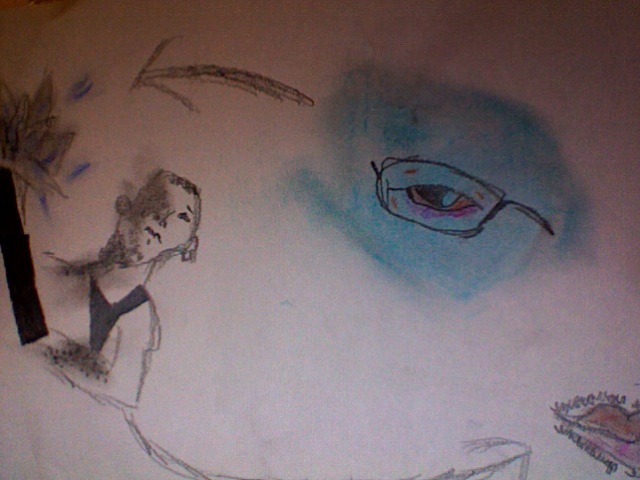




each collage is either representative of something so important or is of a person that's influenced me or molded me in my seventeen years
Thank you all so much for what you've done for me, I would be a different person without you. I'm missing some people, but I'm doing my best to represent you or include you.
This isn't completely spontaneous, but in honor of my graduation.
Class of 2011!!!
Tuesday, May 10, 2011

Wednesday, April 6, 2011
In many cases it isn’t suitable to change environments when you’re accustomed to a certain pace the majority of your life. If you’re a down to earth Chicago boy, it might be a shock to transition to the glamorous jazz scene of 1920’s Long Island Sound. In The Great Gatsby by F. Scott Fitzgerald, Nick, a simple young man from Chicago, moves to West Egg Long Island Sound to work in New York City. As soon as he arrives, he is constantly haunted by the luring upbeat rhythms of jazz and enchanted by the sparkles and fast moving steps of upper class people enjoying the parties thrown by his mysterious neighbor Jay Gatsby. Externally, the novel can be seen as an insiders glimpse to American culture and society in the 20’s. But to Nick the novel is about a group of deeply disturbed socialites who each share an extensive list of flaws, despite their stature. Daisy is one of the main characters who is both involved with her husband Tom and former lover Gatsby. The author uses Daisy to personify societies attitude during that time period, the struggles and purpose of women, as well as reveals her personal flaws as a main character.
It is widely believed that one always wants what one doesn’t have. It is a saying that relates to modern times as well as the era the novel is set in. It is only one of many factors in modern day society, but if you were rich in the 1920s it was a saying that controlled your life. For the Buchanan’s it was the name of the game. Daisy and Tom went from fabulous estates in Chicago, to Long Island Sound, New York City, and eventually even to Europe. They are never happy with what they have, and spend fortunes buying estate after estate. Daisy is born into money and raised down South. She is properly educated, well mannered, dressed to the nines, and trained to be everything a wife is supposed to be. To the outside world she looks like a pretty well trained host with enthusiasm and class, but inside she is completely empty. No matter how many materialistic possessions she acquires she still lacks happiness, even when she tries to distract herself from the pain. She uses her affair with Gatsby to distract herself from the pain, but instead she negatively affects him and puts him at equal displeasure. Daisy symbolizes the main attitude and culture in America during that time. America in the 1920’s was all about a class system. If you were upper class, which was what everybody worked towards, you were never satisfied and concerned mostly with parties and reputation. But underneath all the fancy suits, cars, and houses one was never truly happy. For example, Gatsby tries to attain as much money as possible in order to win Daisy, but in the end of the novel he ends up alone and murdered. Wilson, a low class gas station owner, is merely content with the love he has for his wife Myrtle. Myrtle; however, is not content living as a low class citizen and tries to climb the social latter through her affair with Tom, and in the end she is also left alone and murdered. Daisy is American society in the 1920’s. She is poised, proper, pretty, educated, empty, and leads a meaningless sad life.
Every girl raised in upper class society was well educated because it was a trait that appealed to upper class boys, but not every well-educated girl mastered the art of common sense. In fact, Daisy is a rare exception. Daisy is admired in society because she seems to possess every quality a well-rounded girl should have, but she is empty and depressed because she has enough intelligence and common sense to see past false pretenses. Daisy knows that her husband Tom married into a label of a girl society thinks he should have. She is also aware of the fact that her parents sold her off like a prize horse, and she isn’t allowed to do anything about Tom’s affairs because she is merely a woman owned by a man. Her name, interests, and passions are irrelevant because her only purpose in life is to bear Tom’s children and play hostess to Tom’s friends. The audience is aware of Daisy’s depression from the beginning of the novel, but the author only reveals the reasons for her sadness slowly throughout the course of the plot. For example, when Nick first arrives at the Buchanan’s estate and Daisy and him are alone for the first time, Nick raises the subject of her daughter, “Well, she was less than an hour old and Tom was God knows where. I woke up out of the ether with an utterly abandoned feeling, and asked the nurse right away if it was a boy or a girl. She told me it was a girl, and so I turned my head away and wept. ‘All right,’ I said, ‘I’m glad it’s a girl. And I hope she’ll be a fool-that’s the best thing a girl can be in this world, a beautiful little fool.’” Daisy is intelligent, and her intelligence allows her to know better; therefore, she is empty and depressed. She understands the binding circumstances rich women are forced into, and she’d rather her daughter be stupid and not know better then sad and depressed. Daisy is also intelligent enough to understand that rich girls don’t marry poor boys, regardless of love and happiness. Mid novel, Jordan Baker meets Nick for tea and explains Gatsby and Daisy’s relationship, “She began to cry-she cried and cried. I rushed out and found her mother’s maid, and we locked the door and got her into a cold bath. She wouldn’t let go of the letter. She took it into the tub with her and squeezed it up into a wet ball, and only let me leave it in the soap-dish when she saw that it was coming to pieces like snow. But she didn’t say another word. We gave her spirits of ammonia and put ice on her forehead and hooked her back into her dress, and half an hour later, when we walked out of the room, the pearls were around her neck and the incident was over. Next day at five o’clock she married Tom Buchanan without so much as a shiver, and started off on a three months’ trip to the South Seas.” Daisy receives a letter from Gatsby the night before her wedding and is absolutely distraught over the subject because his written words remind her of true love. However, she goes on with her wedding because she is smart enough to realize that society won’t allow for a rich girl to marry a soldier.
In The Great Gatsby by F. Scott Fitzgerald, each character is flawed in one way or another. Daisy is the main heroine, and is flawed because she uses other people to lessen her pain. Daisy’s personal situation alludes to all of upper class society in the 1920’s, as well as a woman’s place. She is everything a rich girl should be, but because she knows her true purpose in life, she is sad and depressed. Upper class society in the 1920’s was about parties, reputation, big houses, fancy shirts, and unhappy people who were never satisfied.
It is widely believed that one always wants what one doesn’t have. It is a saying that relates to modern times as well as the era the novel is set in. It is only one of many factors in modern day society, but if you were rich in the 1920s it was a saying that controlled your life. For the Buchanan’s it was the name of the game. Daisy and Tom went from fabulous estates in Chicago, to Long Island Sound, New York City, and eventually even to Europe. They are never happy with what they have, and spend fortunes buying estate after estate. Daisy is born into money and raised down South. She is properly educated, well mannered, dressed to the nines, and trained to be everything a wife is supposed to be. To the outside world she looks like a pretty well trained host with enthusiasm and class, but inside she is completely empty. No matter how many materialistic possessions she acquires she still lacks happiness, even when she tries to distract herself from the pain. She uses her affair with Gatsby to distract herself from the pain, but instead she negatively affects him and puts him at equal displeasure. Daisy symbolizes the main attitude and culture in America during that time. America in the 1920’s was all about a class system. If you were upper class, which was what everybody worked towards, you were never satisfied and concerned mostly with parties and reputation. But underneath all the fancy suits, cars, and houses one was never truly happy. For example, Gatsby tries to attain as much money as possible in order to win Daisy, but in the end of the novel he ends up alone and murdered. Wilson, a low class gas station owner, is merely content with the love he has for his wife Myrtle. Myrtle; however, is not content living as a low class citizen and tries to climb the social latter through her affair with Tom, and in the end she is also left alone and murdered. Daisy is American society in the 1920’s. She is poised, proper, pretty, educated, empty, and leads a meaningless sad life.
Every girl raised in upper class society was well educated because it was a trait that appealed to upper class boys, but not every well-educated girl mastered the art of common sense. In fact, Daisy is a rare exception. Daisy is admired in society because she seems to possess every quality a well-rounded girl should have, but she is empty and depressed because she has enough intelligence and common sense to see past false pretenses. Daisy knows that her husband Tom married into a label of a girl society thinks he should have. She is also aware of the fact that her parents sold her off like a prize horse, and she isn’t allowed to do anything about Tom’s affairs because she is merely a woman owned by a man. Her name, interests, and passions are irrelevant because her only purpose in life is to bear Tom’s children and play hostess to Tom’s friends. The audience is aware of Daisy’s depression from the beginning of the novel, but the author only reveals the reasons for her sadness slowly throughout the course of the plot. For example, when Nick first arrives at the Buchanan’s estate and Daisy and him are alone for the first time, Nick raises the subject of her daughter, “Well, she was less than an hour old and Tom was God knows where. I woke up out of the ether with an utterly abandoned feeling, and asked the nurse right away if it was a boy or a girl. She told me it was a girl, and so I turned my head away and wept. ‘All right,’ I said, ‘I’m glad it’s a girl. And I hope she’ll be a fool-that’s the best thing a girl can be in this world, a beautiful little fool.’” Daisy is intelligent, and her intelligence allows her to know better; therefore, she is empty and depressed. She understands the binding circumstances rich women are forced into, and she’d rather her daughter be stupid and not know better then sad and depressed. Daisy is also intelligent enough to understand that rich girls don’t marry poor boys, regardless of love and happiness. Mid novel, Jordan Baker meets Nick for tea and explains Gatsby and Daisy’s relationship, “She began to cry-she cried and cried. I rushed out and found her mother’s maid, and we locked the door and got her into a cold bath. She wouldn’t let go of the letter. She took it into the tub with her and squeezed it up into a wet ball, and only let me leave it in the soap-dish when she saw that it was coming to pieces like snow. But she didn’t say another word. We gave her spirits of ammonia and put ice on her forehead and hooked her back into her dress, and half an hour later, when we walked out of the room, the pearls were around her neck and the incident was over. Next day at five o’clock she married Tom Buchanan without so much as a shiver, and started off on a three months’ trip to the South Seas.” Daisy receives a letter from Gatsby the night before her wedding and is absolutely distraught over the subject because his written words remind her of true love. However, she goes on with her wedding because she is smart enough to realize that society won’t allow for a rich girl to marry a soldier.
In The Great Gatsby by F. Scott Fitzgerald, each character is flawed in one way or another. Daisy is the main heroine, and is flawed because she uses other people to lessen her pain. Daisy’s personal situation alludes to all of upper class society in the 1920’s, as well as a woman’s place. She is everything a rich girl should be, but because she knows her true purpose in life, she is sad and depressed. Upper class society in the 1920’s was about parties, reputation, big houses, fancy shirts, and unhappy people who were never satisfied.
Sunday, March 20, 2011
The above two photos are poorly taken photos via mac photo booth. They show a ring I created out of washed up sea glass, found on the shores of Staten Island where my aunt Kim resides. She often walks the beach and collects litter, and in her hunt she sometimes finds beautiful pieces of sea glass. In its previous life the sea glass was most likely a beer bottle that drifted out to sea and was exhausted by the ocean, washed up, and turned into interesting soft colorful pieces of glass. I happened to find a piece that fit perfectly on my ring finger. I've had the piece for years, but just recently I decided to make something out of it. I cut up a piece of chain from an old necklace and hot glued it in an interesting pattern to the ring, I finished it off by molding a piece of light pink clay into a mini abstract rose, which I also hot glued to the glass.
Monday, January 24, 2011
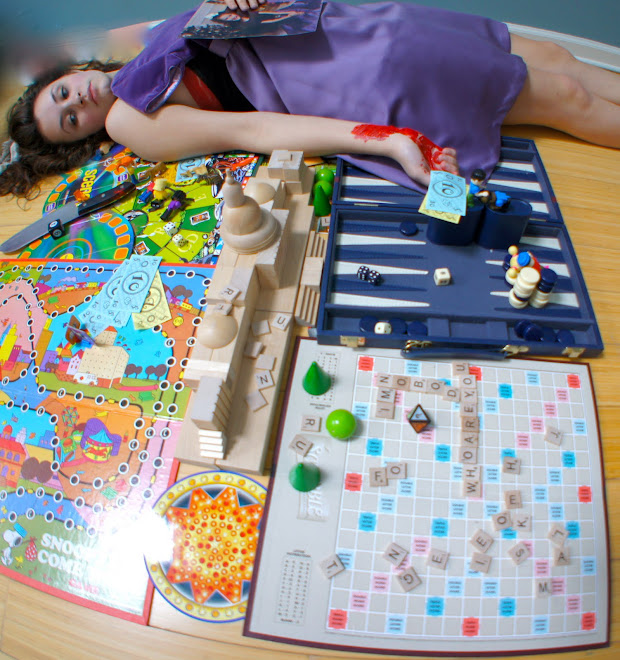
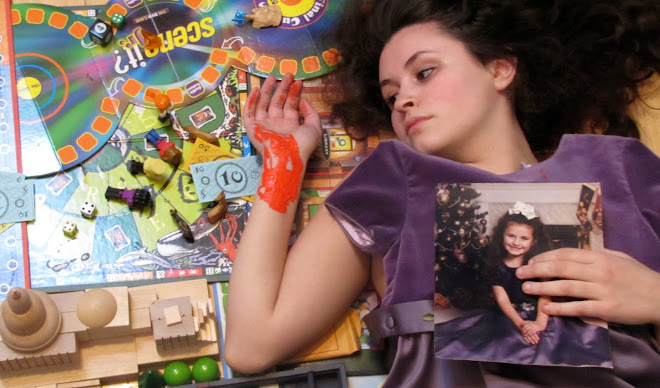
I covered my studios floor with game boards, block fixtures, and varied toy people to create a performing art piece that goes far deeper then childhood memories. Because of a devastating event a decade ago, my childhood was robbed from me. I was forced to grow up much faster then my third grade classmates, and my mother and I switched roles. I took care of the adult, emotionally that is. Not only do I feel my childhood was robbed, I feel children in general are forced to grow up much faster then they truly want to. Societies pressures and the governments regulations, set many a year ago, force humans to take life in steps, and childhood is only half a step. We long to play manhunt on hot summer nights with only fireflies guiding our paths, we long to play with dolls, we long to use our barely developed brains in a match of battle ship, but we are only allotted a short amount of time to do so in peace. We are taught to grow up in a split second because that's what is seen as acceptable in society. But children are fragile and should be allowed to grow at the pace they want, and more importantly play games and dress up dolls for as long as they please. We wonder why so many adults are mad, depressed, delirious, and down right crazy, but it's because so many of us are forced to live at a pace SOMEONE ELSE set. In my piece I show different game boards as the landscape and basis, and a built block pentagon in the middle of it all, after all, behind innocence and games is societies pressures and the governments control. Lego people and small wooden animals are set in compromising sexual positions, showing we are subconsciously forced to do things before we're ready. I also chose to show the wooden animals using technology, little plastic phones from the game Scene It, to show the irony in forcing people to take life by steps, much like it's ironic and wrong for an animal to be chatting on a cell phone. I am naked in my piece with a dress placed on top of me, a dress I wore when I was six years old to my Aunt Kim's christmas party. I lay on the board games holding a picture of me when I was six, wearing the exact same dress sitting in front of the christmas tree with a picturesque fire blazing. My wrist is covered in red paint, referencing death, and symbolizing the death of childhood. I hold a knife.
Sunday, November 14, 2010
She laid her head on the cold gym mat. A towel? That’s all we get for protection, for warmth? Exhaustion was colored in the black circles under her eyes. That game we played last night was ridiculous, but she seems to think it was worth the exhaustion. It’s never a good idea to put your hand between the snapping gates of Jake’s snout, but her father laughed from the irritation the dog felt, which only pushed her. She gets naptime, but my kind never catches a break. Always voluminous and forever tangled, if only she’d buy more of that leave in conditioner! Mrs. D smeared cheap costume crayon on her lips and teeth. She cleared her throat and announced the children would have twenty minutes of naptime today. Holly had sarcasm plastered from cheek to cheek, “Wow Mrs. D, you’re a saint” sort of thing. Mrs. D noticed, “If you don’t wipe that smirk off your face it’ll be a ten minute snooze,” like anyone cared. God she’s tacky, and her hair looks like it’s made of bricks and plaster! How does she manage to walk indoors? Does her hair block her from entering classrooms? The smell of cheap 80’s hairspray suffocated the children as they tried to sleep, and the sound of chunky jewels smacking against the cherry oak went off like a bomb. How can these five year olds bear it? “Nap times over! Snap out of it!” I guess they don’t have time to even try bearing it, Mrs. D wouldn’t allow that. Holly arose obnoxiously, and quite theatrically winning the giggles of a few classmates. Mrs. D wasn’t giggling, her eyes, disguised by layers of blue eye shadow, gleamed with evil intention. “Okay smart mouth, come up to the board and do what I say,” Holly dragged her feet and put on a pout, this could only be bad. Bad is the only thing Mrs. D knows, she lives and breathes bad. “Write six plus seven on the board…with the answer,” Holly can do math, but after excess mental abuse through Mrs. D it’s become a fear. With a shaky hand, the slender chalk embraced the board as Holly’s classmates pierced holes in her back. All they could do was tease, and through their teasing they judged. A five year olds brain is a sponge seeping with information mimicked from television and movies. Parents these days are too selfish to take their kid to the park, so instead they squat them mindlessly in front of a TV. Whatever happened to feeding the ducks? It works for both of us. Children need to realize the sunlight is good for their hairs physical appearance, except if you’re blonde. Holly began to cry, fat tears rolled down her cheeks even as she bit her lip in protest. She looked to Mrs. D, even as a five year old she knew to seek help from adults, but Mrs. D grinned as she smacked a wad of gum between her cheap lips and scarlet stained teeth. Mrs. D barely gave Holly a chance to suck back tears and think before she blurted, “What are you in LaLa Land?” With those simple words, disguised in an ugly Brooklyn accent, Holly fled from the room as laughter chased from behind. She ran passed every jail cell of a classroom, and right out the front door into the sunny Manhattan day. She passed the little corner deli, where the owner always charged a dollar less to all her purchases. She stopped for just a moment to gaze at the mouth drooling pickles floating in the jar, Holly picked up her craving for pickles from her dad. They both loved to drink pickle juice out of the jar with straws; Holly’s mom was always repulsed by it. The disapproval her mother expressed from the pickles reminded her of her judgmental classmates so she continued down the solemn street. It was a sunny Manhattan day in October, and all though such a thing is rare, Holly couldn’t enjoy it. The sun reflecting in the street turned into black clouds enveloping every smile and every vibrant tree plot lining the block. At least for Holly, but the sunshine felt warm and comforting to me. Holly walked in a trance all the way home, her mom was surprised to see her five year old coming home an hour early and alone. After surprise sunk in, panic took over as Holly’s mother grabbed her and shook her like a rag doll. Holly told the entire story, and mentioned this was one of many incidents involving Mrs. D and her self-esteem. Holly’s mom called her small Lutheran school and reported Mrs. D. The next day at school Holly volunteered to go to the board, where she solved math problems with confidence and ease, and a little flash of the tongue to spite Mrs. D.
Thursday, October 21, 2010
‘For the use of such ghosts as choose to inhabit it?’ I observed. ‘No, Mr. Lockwood,’ said Nelly, shaking her head. ‘I believe the dead are at peace: but it is not right to speak of them with levity.’ At that moment the garden gate swung to; the ramblers were returning. ‘They are afraid of nothing,’ I grumbled, watching their approach through the window. ‘Together, they would brave Satan, and all his legions.’ As they stepped on to the door-stones, and halted to take a last look at the moon-or, more correctly, at each other by her light-I felt irresistibly impelled to escape them again; and, pressing a remembrance into the hand of Mrs. Dean, and disregarding her expostulations at my rudeness, I vanished through the kitchen as they opened the house-door; and so should have confirmed Joseph in his opinion of his fellow-servant’s gay indiscretions, had he not fortunately recognized me for a respectable character by the sweet ring of a sovereign at his feet. My walk home was lengthened by a diversion in the direction of the kirks. When beneath its walls, I perceived decay had made progress, even in seven months: many a window showed black gaps deprived of glass; and slates jutted off, here and there, beyond the right line of the roof, to be gradually worked off in coming autumn storms. I sought, and soon discovered, the three headstones on the slope next the moor: the middle one grey, and a half buried in heath; Edgar Linton’s only harmonized by the turf and moss creeping up its foot; Heathcliff’s still bare. I lingered round them, under that benign sky: watched the moths fluttering among the heath and harebells, listened to the soft wind breathing through the grass, and wondered how any one could ever imagine unquiet slumbers for the sleepers in that quiet earth.”
The afterlife doesn’t always have religious affiliations. Ones own personal spiritual connection doesn’t change depending on whether they are Christian or Buddhist. The afterlife and what happens to an individual when they die is completely unclear, but some might say that a spiritual connection is more closely related to actions rather then a belief system. The last passage in the novel Wuthering Heights by Emily Bronte is a microcosm in respect to the entire novel. But what’s displayed in that one passage emphasizes a major theme throughout the storyline, and that theme is the overpowering effect the dead have on the living. The power the dead have on the living is not only a spiritual haunting, but they also have a physical effect on living characters. The main focus of the passage emphasizes how the dead can exert a powerful effect on a character that is still alive; the dead are a catalyst for change, and haunt characters thoughts and feelings.
Although it’s unclear what the after life is, it’s clear that the effect the dead have in memory, and in an unearthly presence is empowering and can change the personalities of the living. Nelly Dean was deeply involved in the lives of the characters that eventually die. Nelly was so involved in the lives of other people that she became distant from herself, but she maintains a calm and collected personality. But when all of the main characters are dead, and young Catherine and Hareton move on in their lives, Nelly is finally left to take care of herself rather then caring for others. But Nelly spent so much time caring for others that she subconsciously discovers she’s distant from herself, and this is apparent in her words. Lockwood comes to the moors for an update and in conversation Nelly says, “’No, Mr. Lockwood,’ said Nelly, shaking her head. ‘I believe the dead are at peace: but it is not right to speak of them with levity.’” In context Nelly is snippy with Lockwood, where before she was open and enthusiastic when telling her tales. Nelly dreads the idea of the dead continuing to haunt the moors and it’s apparent when she tells Lockwood to be respectful, hoping the chances of keeping them away will advance. Heathcliff often confessed to Nelly that Catherine haunts him, but she never believed in such foolishness. But as soon as Nelly is left to deal with herself her own personal ghosts come out to haunt her, and the dead trigger these burdens. These ghosts represent the traumatizing memories the dead characters imbedded in her mind when they were alive, and the reminder that she doesn’t know who she truly is because she never had time for herself. When the characters were alive Nelly was verbal and open, and never believed the after life could effect her. But when the characters are dead Nelly is left alone and therefore her personality transforms, as shown in the last passage.
Lockwood thrives through the simple words that flow out of Nelly’s mouth. He is an outsider in the novel, and never knew two of the three dead characters. The third dead character, Heathcliff, he only met three times. Yet he is still consumed and obsessed with Nelly’s recollection of their lives. Lockwood eventually leaves the moors because he fears the isolation, and after only meeting Heathcliff three times, he fears he may become like the conniving character if he stays. During his time away, Heathcliff dies, and in some ways Lockwood is so consumed by the story that me might have sensed Heathcliff’s death, causing his return. At first glance this return can be seen as an act of curiosity. But deeper down he has become so obsessed with the story that he has let the dead control his mind and actions. When talking to Nelly Dean Lockwood blurts, “For the use of such ghosts as choose to inhabit it?” His thoughts are so consumed by the dead that he almost hopes they will haunt the moors, that way he may get a chance to experience them from a perspective besides a story. Lockwood is well bred and wealthy, yet he exerts this rude and disrespectful question in front of Nelly without hesitation. His obsession starts to lead him from his routinely ways, and his rude statement even reflects the likes of Heathcliff, someone he tried to escape once before. The dead have such a large control over his thoughts and feelings that his own personality starts to alter in reflection of the dead Heathcliff. His emotional attachment to the story is so strong that it takes over his life, and leads him to the cemetery where Catherine, Edgar, and Heathcliff lie. Lockwood observes, “…and wondered how any one could ever imagine unquiet slumbers for the sleepers in that quiet earth.” The control the dead have on Lockwood’s emotions and thoughts come to peace in this scene, much like nature allows the dead to come to peace in the afterlife. When Lockwood physically sees that the dead have rest all conflict and come to peace with nature, it allows his own mind to accept reality and make peace with nature. He is finally able to part with his own ghosts.
What happens to people when they die was unclear in the time Wuthering Heights, and remains unclear in present day. Memories as well as a super natural presence affect the lives of the living characters in the novel; the dead characters have the ability to alter personalities and control mind and emotion. Although the dead has the ability to control and alter the lives of the living, the living has the ability to stop the dead. Both the abilities of the living and the abilities of the dead are displayed throughout the novel, and both are displayed in the last passage. It’s fact that Catherine, Edgar, and Heathcliff have the effect to alter the personalities and emotions of the living characters, but it’s also fact that the living characters are able to overcome their power by finding peace with nature. Ironically, the peace the living characters find in nature is a gift from the dead. The dead characters are able to find peace with nature in the afterlife, and that realization allows the living to find peace with their ghosts.
>>essay I wrote focusing on the thematic motif of death, something that is natural in life and supernatural throughout eternity.
The afterlife doesn’t always have religious affiliations. Ones own personal spiritual connection doesn’t change depending on whether they are Christian or Buddhist. The afterlife and what happens to an individual when they die is completely unclear, but some might say that a spiritual connection is more closely related to actions rather then a belief system. The last passage in the novel Wuthering Heights by Emily Bronte is a microcosm in respect to the entire novel. But what’s displayed in that one passage emphasizes a major theme throughout the storyline, and that theme is the overpowering effect the dead have on the living. The power the dead have on the living is not only a spiritual haunting, but they also have a physical effect on living characters. The main focus of the passage emphasizes how the dead can exert a powerful effect on a character that is still alive; the dead are a catalyst for change, and haunt characters thoughts and feelings.
Although it’s unclear what the after life is, it’s clear that the effect the dead have in memory, and in an unearthly presence is empowering and can change the personalities of the living. Nelly Dean was deeply involved in the lives of the characters that eventually die. Nelly was so involved in the lives of other people that she became distant from herself, but she maintains a calm and collected personality. But when all of the main characters are dead, and young Catherine and Hareton move on in their lives, Nelly is finally left to take care of herself rather then caring for others. But Nelly spent so much time caring for others that she subconsciously discovers she’s distant from herself, and this is apparent in her words. Lockwood comes to the moors for an update and in conversation Nelly says, “’No, Mr. Lockwood,’ said Nelly, shaking her head. ‘I believe the dead are at peace: but it is not right to speak of them with levity.’” In context Nelly is snippy with Lockwood, where before she was open and enthusiastic when telling her tales. Nelly dreads the idea of the dead continuing to haunt the moors and it’s apparent when she tells Lockwood to be respectful, hoping the chances of keeping them away will advance. Heathcliff often confessed to Nelly that Catherine haunts him, but she never believed in such foolishness. But as soon as Nelly is left to deal with herself her own personal ghosts come out to haunt her, and the dead trigger these burdens. These ghosts represent the traumatizing memories the dead characters imbedded in her mind when they were alive, and the reminder that she doesn’t know who she truly is because she never had time for herself. When the characters were alive Nelly was verbal and open, and never believed the after life could effect her. But when the characters are dead Nelly is left alone and therefore her personality transforms, as shown in the last passage.
Lockwood thrives through the simple words that flow out of Nelly’s mouth. He is an outsider in the novel, and never knew two of the three dead characters. The third dead character, Heathcliff, he only met three times. Yet he is still consumed and obsessed with Nelly’s recollection of their lives. Lockwood eventually leaves the moors because he fears the isolation, and after only meeting Heathcliff three times, he fears he may become like the conniving character if he stays. During his time away, Heathcliff dies, and in some ways Lockwood is so consumed by the story that me might have sensed Heathcliff’s death, causing his return. At first glance this return can be seen as an act of curiosity. But deeper down he has become so obsessed with the story that he has let the dead control his mind and actions. When talking to Nelly Dean Lockwood blurts, “For the use of such ghosts as choose to inhabit it?” His thoughts are so consumed by the dead that he almost hopes they will haunt the moors, that way he may get a chance to experience them from a perspective besides a story. Lockwood is well bred and wealthy, yet he exerts this rude and disrespectful question in front of Nelly without hesitation. His obsession starts to lead him from his routinely ways, and his rude statement even reflects the likes of Heathcliff, someone he tried to escape once before. The dead have such a large control over his thoughts and feelings that his own personality starts to alter in reflection of the dead Heathcliff. His emotional attachment to the story is so strong that it takes over his life, and leads him to the cemetery where Catherine, Edgar, and Heathcliff lie. Lockwood observes, “…and wondered how any one could ever imagine unquiet slumbers for the sleepers in that quiet earth.” The control the dead have on Lockwood’s emotions and thoughts come to peace in this scene, much like nature allows the dead to come to peace in the afterlife. When Lockwood physically sees that the dead have rest all conflict and come to peace with nature, it allows his own mind to accept reality and make peace with nature. He is finally able to part with his own ghosts.
What happens to people when they die was unclear in the time Wuthering Heights, and remains unclear in present day. Memories as well as a super natural presence affect the lives of the living characters in the novel; the dead characters have the ability to alter personalities and control mind and emotion. Although the dead has the ability to control and alter the lives of the living, the living has the ability to stop the dead. Both the abilities of the living and the abilities of the dead are displayed throughout the novel, and both are displayed in the last passage. It’s fact that Catherine, Edgar, and Heathcliff have the effect to alter the personalities and emotions of the living characters, but it’s also fact that the living characters are able to overcome their power by finding peace with nature. Ironically, the peace the living characters find in nature is a gift from the dead. The dead characters are able to find peace with nature in the afterlife, and that realization allows the living to find peace with their ghosts.
>>essay I wrote focusing on the thematic motif of death, something that is natural in life and supernatural throughout eternity.
Sunday, September 12, 2010
“For times they are a changin’” Bob Dylan saw the world through futuristic eyes. He saw the world with accepted civil rights, and world conflictions being solved with conversation and music rather then wars. He saw all people treated and accepted as total equals by their morals rather then their race or cultural backgrounds. He was a rebellious peacemaker, he caused a riot at the Newport Folk Festival in 1965 when he went on stage and played his normal folk music in electric heavy medal guitar. His radical ways of making points are all for the cause of getting societies attention to issues like civil rights and anti-war, the heavy slashes of the notes flowing from the guitar were ways of expressing war, and illustrating how war invades on peaceful communities, much like the heavy medal he played interrupted the peace of the folk festival. Bob Dylan was born Robert Albert Zimmerman and is foremost an American singer, songwriter, and musician. He composes all of his music down to the very technical threads, and because of this his music is very raw, but still has a point and is musically phenomenal. He was the Holden Caulfield of 1960s America and was the head spokesperson in opposing societies imperfections; he was a form of an activist most would say. Dylan expressed his activist point of view through what he knew best, his music. His songs like “Blowin’ In The Wind” and “Times They Are a-Changin’” express societies ignorance towards racial segregation and the violence in war and the ironic component in America of fighting a war for peace. His lyrics were philosophical, political, and enlightening to every listener no matter what the interpretation. He was multitalented in the fact that he could sing and compose folk, blues, rock and roll, gospel, and country music. He even contributed to jazz, swing, and Irish folk music. He toured through every musical endeavor he went about, and his most famous tour was in the 1980s known as “The Never Ending Tour”. His work has been so significant to society that he has won Grammy’s, Academy Awards, Golden Globes, and is in the Rock and Roll Hall of Fame. Amazingly, in 2008 years after the significant part of his career had passed he received a Pulitzer Prize for his musical work, and his work as an activist through music. Dylan is significant to U.S. history because all though he wasn’t a major event or a president, he used his musical talents and his good morals to stand up for what was right. He pushed until Civil Rights were accepted, and to this day still protests war and other imperfection in U.S. society. The most phenomenal part is he did this through music, a network that intrigues millions of people and creates fan addicts, and addicts who fought for the same causes he did.
Falling down a rabbit hole and hitting ones head seemed to clarify the scrambled thoughts in young Alice’s brain, and after her sudden awakening she was able to travel through Wonderland, and then back to reality with a sudden realization of her future and her goals. This is both true in Lewis Carroll’s book Alice’s Adventure’s in Wonderland and the movie adaption recently directed by visionary artist Tim Burton. But one doesn’t have to have tea with a demented hatter in Wonderland to find their path and meaning in life. In fact, works of literature that are both mandatory in life and amusement in a boring world have a star character that is often on the path to self-discovery. In the novel Jane Eyre by Charlotte Bronte, the protagonist is a young woman named Jane. The novel is a bildungsroman taking the audience on the path from childhood to adulthood, but simultaneously taking the audience on a trip to find Jane’s true self. Much like the character Alice, who finds her true identity by traveling through Wonderland, Jane is also aided by magic. A major theme in the novel is Jane’s overall search and discovery of her true self, but magical symbols are placed throughout the novel to aid Jane, much like Wonderland aided Alice.
The majority of society doesn’t believe in magic. Most people are convinced that magic and fairy tales exist because they’re useful to teach children right from wrong, in a style that captures the child’s imagination. But even in fully developed novels magic can exist. It’s hard for the common person to believe in such ridiculous ideas because magic doesn’t come to the common person. Jane Eyre experiences guidance from different forms of magic throughout the novel because she is an extremely unique individual. Her unique personality was most likely developed from her childhood of neglect. Jane’s parents died during her infancy, and her nasty Aunt Reed at Gateshead estate raised her. Jane also grew up with her three cousins, the eldest being cruel and obviously a copycat of his mother. As a child Jane kept to herself, and was mostly occupied by books. But not the typical fairy tale books that often occupy a child’s attention, instead Jane was mainly interested in books illustrating gothic scenes and deathly looking birds. The gothic scenes in the books foreshadow Jane’s future life living at Thornfield, the creepy estate owned by her future husband Rochester, her viewing of the book as a child can be interpreted as a magical sign leading her in that general direction. When Jane is ten years old she is blamed for a fight between her and her cousin, he attacks her and she defends herself, but her cruel Aunt Reed solely blames her. As punishment she is sent to the “red room” that occupies no one, is too small to live in, and she spends an entire day and night there. As a result, Jane becomes claustrophobic and eventually she grows very ill, and in her time in the room she claims to see her dead Uncle Reed’s ghost and it causes her to melt down. The results of her melt down lead to the annoyance of her Aunt Reed, and from that annoyance her Aunt Reed sends Jane to a boarding school called Lowood. The ghost is a magical form, and he takes her from one step to the other on her path to self-discovery. Without the guidance from the ghost of her Uncle Reed, she might have never made it out of Gateshead.
Her time at Gateshead is her time as a small child, but as she reaches the eerie dorms of a school run solely by a patriarch, she begins her time as a young adult, and as a young adult she meets the first person to love her, and discovers her own kind of love. The first person to love her is one of the first healthy relationships she has ever had, when she meets her best friend, Helen Burns, they immediately connect and watch over each other. In Jane’s spare time she also develops a love for painting, and her paintings often illustrate birds. Birds connect with not only the books she read as a child, but they also show the true colors of Jane’s personality. Birds are obviously free because they fly, and although Jane can’t physically fly she internally longs to be free, and her path to self-discovery is also a path to find freedom through something or someone. Throughout the novel Jane doesn’t stay in one location for long, and this is because she wont stop until she finds her true self, much like a bird doesn’t stay put because of migration. Again, the birds in the books and the birds in her paintings symbolize her longings and her actions, the birds are signs and signs are a form of magic. Eventually, as Jane and Helen grow Helen becomes ill and eventually dies in Jane’s arms. Shortly after Helen’s death, Jane reaches an age where she is no longer a student, and the school asks her if she will become a teacher, but Jane turns the opportunity down. However, sleeping in her dorm later that night she is completely lost and doesn’t know where to go, and so she asks if a fairly will leave her an idea on her pillow. When she awakes the next morning, she has a clear idea of what she wants to do, and decides to make an advertisement in the paper for a governess position. Before she fell asleep she had no idea what she wanted to do after Lowood, but when she asks a fairy for help, she awakes with a clear and precise vision. Much like the ghost at Gateshead, the magical fairy at Lowood guides her to her next step on her path to self-discovery.
The moon is depicted as a feminine light in our universe. Her light illuminates the darkness, and she gives guidance and nurtures all, much like a mother. She influences the waves in the process of waning and waxing, and on Jane’s long dark journey from Lowood to Thornfield, she sheds light for Jane to see and gives off positive energy. The moon is recognized in all cultures as mythological, and is therefore depicted as a form of magic. Jane is hired as a governess to young Adele, her guardian being the owner of the estate Thornfield. Rochester is just as average to the naked eye as Jane is, but he is also equivalent to Jane internally, therefore he is complex. Eventually, and unexpectedly Jane and Rochester fall in love and engage to be wed. But the events leading to the wedding put Jane on edge, and she convinces herself ghostly secrets lie behind the polished walls of the mansion. One night she awakes to find a pale bloody woman standing over her bed wearing her wedding veil. Previous to this incident a fire was started in Rochester’s bedroom, and when Jane volunteers to investigate with him he overly reacts and refuses to let her come, giving her proper reason to question him and his house. Another incident leads to the mysterious stabbing of a guest staying at the house, and Jane is left to mend him. She is given strict instructions not to go through the door in the room she is left in. While she is in the room she notices a fixture of Jesus hanging on the wall, Jesus is a symbol of the irony in the situation. Jesus is a holy symbol, but whatever force lies behind that forbidden door is far from holy. When Jane sees the woman in her room, her first thought is that the woman is a vampire. A vampire is a made up creature, but nonetheless a magical one. The fixture of Jesus lies next to the room where the vampire like woman lives, and the contrast between the two is noticeable to Jane. Eventually, when she discovers Rochester’s secret she refers to this contrast and its unholy vibes, and it leads her to her next step, among other things. The contrast is bad for obvious reasons. Magical symbolism and its contrast help her in her decision to leave Thornfield, both the miracle of Jesus and the existence of a vampire are forms of magic. The existence of the vampire like woman and her secrets chase Jane away from Thornfield and her true love, but they also bring her back to Thornfield, at the end of the novel. When she returns to Thornfield for the second and last time, her journey to self-discovery is over and she understands her true self.
Jane Eyre spends her journey from childhood to adulthood searching for freedom and self-discovery. Eventually she reaches a point in maturity, where she discovers who she truly is, through falling in love. But before she got to that point, she traveled from place to place learning and running from different people and different concepts. But she wouldn’t have reached a success point if magical symbols didn’t properly aid her. Not only did magic give her directions and guidance, but also magic showed her different pieces of herself, gradually, throughout her journey.
The majority of society doesn’t believe in magic. Most people are convinced that magic and fairy tales exist because they’re useful to teach children right from wrong, in a style that captures the child’s imagination. But even in fully developed novels magic can exist. It’s hard for the common person to believe in such ridiculous ideas because magic doesn’t come to the common person. Jane Eyre experiences guidance from different forms of magic throughout the novel because she is an extremely unique individual. Her unique personality was most likely developed from her childhood of neglect. Jane’s parents died during her infancy, and her nasty Aunt Reed at Gateshead estate raised her. Jane also grew up with her three cousins, the eldest being cruel and obviously a copycat of his mother. As a child Jane kept to herself, and was mostly occupied by books. But not the typical fairy tale books that often occupy a child’s attention, instead Jane was mainly interested in books illustrating gothic scenes and deathly looking birds. The gothic scenes in the books foreshadow Jane’s future life living at Thornfield, the creepy estate owned by her future husband Rochester, her viewing of the book as a child can be interpreted as a magical sign leading her in that general direction. When Jane is ten years old she is blamed for a fight between her and her cousin, he attacks her and she defends herself, but her cruel Aunt Reed solely blames her. As punishment she is sent to the “red room” that occupies no one, is too small to live in, and she spends an entire day and night there. As a result, Jane becomes claustrophobic and eventually she grows very ill, and in her time in the room she claims to see her dead Uncle Reed’s ghost and it causes her to melt down. The results of her melt down lead to the annoyance of her Aunt Reed, and from that annoyance her Aunt Reed sends Jane to a boarding school called Lowood. The ghost is a magical form, and he takes her from one step to the other on her path to self-discovery. Without the guidance from the ghost of her Uncle Reed, she might have never made it out of Gateshead.
Her time at Gateshead is her time as a small child, but as she reaches the eerie dorms of a school run solely by a patriarch, she begins her time as a young adult, and as a young adult she meets the first person to love her, and discovers her own kind of love. The first person to love her is one of the first healthy relationships she has ever had, when she meets her best friend, Helen Burns, they immediately connect and watch over each other. In Jane’s spare time she also develops a love for painting, and her paintings often illustrate birds. Birds connect with not only the books she read as a child, but they also show the true colors of Jane’s personality. Birds are obviously free because they fly, and although Jane can’t physically fly she internally longs to be free, and her path to self-discovery is also a path to find freedom through something or someone. Throughout the novel Jane doesn’t stay in one location for long, and this is because she wont stop until she finds her true self, much like a bird doesn’t stay put because of migration. Again, the birds in the books and the birds in her paintings symbolize her longings and her actions, the birds are signs and signs are a form of magic. Eventually, as Jane and Helen grow Helen becomes ill and eventually dies in Jane’s arms. Shortly after Helen’s death, Jane reaches an age where she is no longer a student, and the school asks her if she will become a teacher, but Jane turns the opportunity down. However, sleeping in her dorm later that night she is completely lost and doesn’t know where to go, and so she asks if a fairly will leave her an idea on her pillow. When she awakes the next morning, she has a clear idea of what she wants to do, and decides to make an advertisement in the paper for a governess position. Before she fell asleep she had no idea what she wanted to do after Lowood, but when she asks a fairy for help, she awakes with a clear and precise vision. Much like the ghost at Gateshead, the magical fairy at Lowood guides her to her next step on her path to self-discovery.
The moon is depicted as a feminine light in our universe. Her light illuminates the darkness, and she gives guidance and nurtures all, much like a mother. She influences the waves in the process of waning and waxing, and on Jane’s long dark journey from Lowood to Thornfield, she sheds light for Jane to see and gives off positive energy. The moon is recognized in all cultures as mythological, and is therefore depicted as a form of magic. Jane is hired as a governess to young Adele, her guardian being the owner of the estate Thornfield. Rochester is just as average to the naked eye as Jane is, but he is also equivalent to Jane internally, therefore he is complex. Eventually, and unexpectedly Jane and Rochester fall in love and engage to be wed. But the events leading to the wedding put Jane on edge, and she convinces herself ghostly secrets lie behind the polished walls of the mansion. One night she awakes to find a pale bloody woman standing over her bed wearing her wedding veil. Previous to this incident a fire was started in Rochester’s bedroom, and when Jane volunteers to investigate with him he overly reacts and refuses to let her come, giving her proper reason to question him and his house. Another incident leads to the mysterious stabbing of a guest staying at the house, and Jane is left to mend him. She is given strict instructions not to go through the door in the room she is left in. While she is in the room she notices a fixture of Jesus hanging on the wall, Jesus is a symbol of the irony in the situation. Jesus is a holy symbol, but whatever force lies behind that forbidden door is far from holy. When Jane sees the woman in her room, her first thought is that the woman is a vampire. A vampire is a made up creature, but nonetheless a magical one. The fixture of Jesus lies next to the room where the vampire like woman lives, and the contrast between the two is noticeable to Jane. Eventually, when she discovers Rochester’s secret she refers to this contrast and its unholy vibes, and it leads her to her next step, among other things. The contrast is bad for obvious reasons. Magical symbolism and its contrast help her in her decision to leave Thornfield, both the miracle of Jesus and the existence of a vampire are forms of magic. The existence of the vampire like woman and her secrets chase Jane away from Thornfield and her true love, but they also bring her back to Thornfield, at the end of the novel. When she returns to Thornfield for the second and last time, her journey to self-discovery is over and she understands her true self.
Jane Eyre spends her journey from childhood to adulthood searching for freedom and self-discovery. Eventually she reaches a point in maturity, where she discovers who she truly is, through falling in love. But before she got to that point, she traveled from place to place learning and running from different people and different concepts. But she wouldn’t have reached a success point if magical symbols didn’t properly aid her. Not only did magic give her directions and guidance, but also magic showed her different pieces of herself, gradually, throughout her journey.
Saturday, July 31, 2010
P.S. 1 Contemporary Art Center is an addition to the MoMA Museum of Modern Art; which opened in 1963, and has been affiliated with P.S.1 since January 2000. MoMA young architects exhibit their work at the center in Queens, NY. The center also houses the National/International Projects series, quite an honor in the art world. Although the center is an addition to the MoMA; meaning the work is mostly modern and the walls ceilings and floors of the center are molded into the imagination of young architects, the museum itself is actually one of the oldest in the country. But it wasn't as known UNTIL the MoMA came into play. The center is literally play-dough to the young, modern, and brilliant minds of artists around the country and the world. The physical presence of the museum is the molded imagination of young architects from the MoMA, but the museum is also famous for housing the famous internet art radio station WPS1, since 2004. Not to mention some of the most recent exhibitions are raunchy and completely and totally revolved around the act of sex and the sexual being. Most artists, even modern artists, relate their work to sex in some form of another, but the exhibitions in PS1 don't relate to sex or hint sex, they are sex. Pablo PIcasso might have seemed out there in early 20th century Paris, but this work is the first of it;s kind, and quite expressive/impressive. Daring and totally imaginative, PS1 is a playground for the brilliant minds of visual artists.
Monday, July 26, 2010
i want to be a visual artist more then anything. the nerves and goosebumps that run through my body that pulse through my feelings my five senses my memories my creativity is inspiring and overwhelming when i create art that can be seen and touched. i'm a good artist, but i'm a better writer. i have low confidence but i can say that i can express properly through ink and paper, keyboard and computer functions. proper as my definition of proper. proper as in i can express all that matters and is meaningful through words. i can wrap my mind around different areas of the brain and how each expresses onto paper. that's why when i come to a dilemma it's easiest for me to get it out and solve it by laying it out on paper. a projection of my most tender feelings and misunderstood thoughts on paper, made into an array that almost resembles a piece of visual art. i miss the time when i woke to his name and his words his gold eyes his thick lips i miss when i could see everything i had to live for and everything id have forever pulsating through him and onto my mind. i dont want to have to fabricate tales to steer his attention into caring. i want to wake up again and know i'm on this thoughts and i'm what keeps his heart beating. my sighs are the throbs of his veins..or they used to be. i dont know what to think/ is he nonchalant now because he feels comfortable with us and secure that i am his and feels he no longer needs to treat me delicately and with constant care? maybe i dont know anything and he doesnt care and he just says he does because he pities me. pities me because he knows me better then i know myself, and unfortunately my definition is a sad one because of my history.look it up i swear
Saturday, July 24, 2010
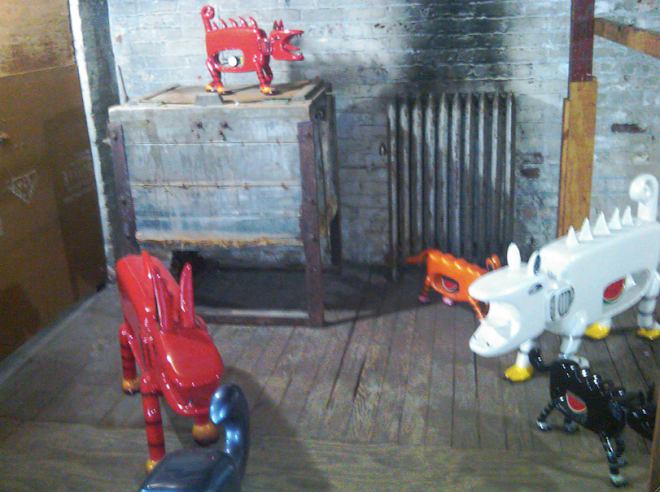
the invisible dog is much like the art work it houses. a multi media of creative and artistic collaborations located @ an historical building in Brooklyn, New York. Historical in it's age but also inventive, not just because of it's current purpose, but from it's original purpose as well. The invisible dog was an old factory in the 1950s until the 1990s that created dog leashes with muzzles in mass productions, and people in America would actually walk down the streets with a wired leash and empty dog muzzle. Women at Studio 54 would be seen with this trendy yet ridiculous accessories. When the fad ended the factory was abandoned until a french man with a degree in theatre came to America to resurrect it. The old beautiful red brick factory in Brooklyn was then made into an exhibit of art, a theatre, and studio space for young and happening artists. A building that was molded into anything any artist that strolled by wanted it to be. Not to mention the theatre built in the basement. Each floor either spaces/ studios for artists, vintage accessories on sale, a theatre, or artists varying exhibits. Not to mention the elevator that takes you to each floor is an actual moving room, a room that's an art exhibit all in itself. Not to mention the vintage accessories, like my white leather hand studded bracelet, originally 5$ and then given to me for free by the french man himself, is a great way to remember the invisible dog forever.
Sunday, June 20, 2010
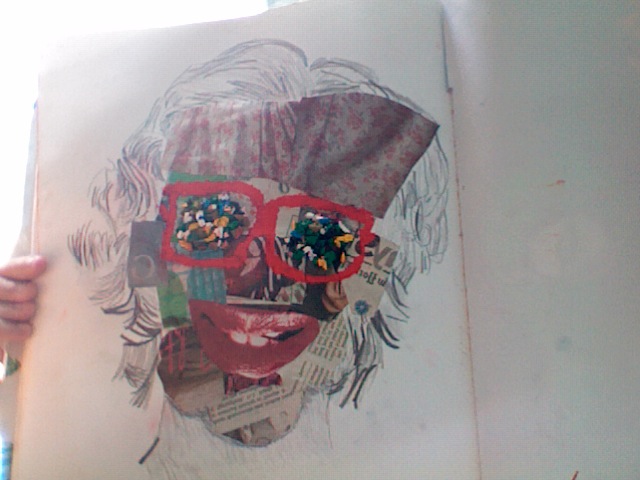
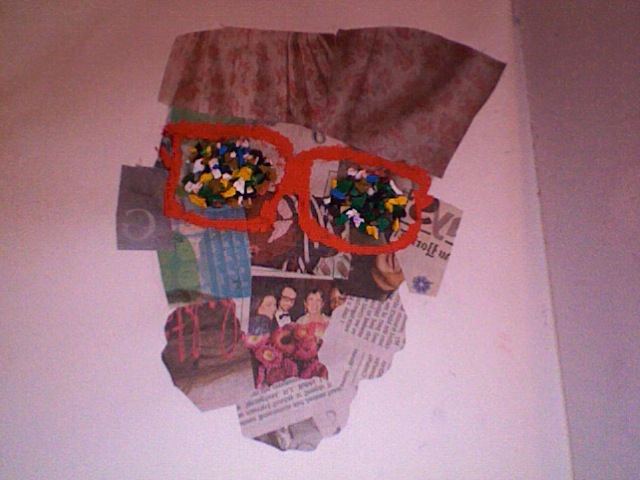
My paint was a splattered mess. I needed to soak my plate for @ least an hour in hot water if i had any hopes in removing the paint mess. I had used thousands of different mixes in order to complete an english assingment where i chose to paint a scene from Pride and Prejudice but incorporate Jane Eyre imagery, boy i lucked out! But alas! Instead of boiling the plate and removing the foot marks to my creative path..I will start a new creative path. I began to chip off the dry paint clumps with scissors and and a knife. After 30 minutes and a large pile of pure colored and tie dye colored chips, I applied them to my next idea. I spent another 30 minutes cutting out scraps from the Sunday Styles section of the NY Times and i used these newspaper scraps, all carefully selected from articles about painting and bouquets of flower arrangements, i used them to collage the replica face of a woman! I applied the paint chips to the eyes of the newspaper woman, and drew funky red glasses out of charcoal around the paint chipped eyes. I drew MArilyn Monroe-esque hair in ink and pencil (are they the same?), and lastly cut out Rocky Horror Picture Show lips for my main ladies lipz!! She is wonderfully beautiful. I feel like ive created a frankenstein, but a frankenstein to my own taste and artistic style =)
ps. i HATE smiley faces like this > :)
i ONLY like these > =)
ps. i HATE smiley faces like this > :)
i ONLY like these > =)
Monday, May 24, 2010
Girls want to look pretty now?
How preposterous girls dressing in floral?colorful chunky jewels? Hair weeped delicately and make up natural and to a minimal?
Sounds nuts!
But actually clean cut and girly is back in style for female fashionistas.
For a while girls in day to day USA and girls of the red carpet were reflecting styles like Balmain military run way looks and girl looks that border-lined you're childhood sweetheart strapped to a motorcycle and obsessed with replicating Bob Dylan in his 1960s iconic phase. Girls were pinned up with smudged dark make up, rips and tears, leather lined in fur, bullets and studs, platform weaponed heals, messy hair that appeals to your bed more then your parents, over sized clothes, and tattoos galore.
But now girls are fresh and clean, and have even started to use make up remover and combs. Hair is swept back delicately and natural and make up is limited and flesh toned. Dresses are an essential and are made for girls without the boyfriend expression, turquoise spring toned colors reflect off naturally organically replenished skins and faces. Although jewelry is still over the top, it's gem stones as opposed to distressed leather with studs. Girls are putting away rock and roll streaks from the 90s and taking out their spring time favorites, with a dash of chunky native american authentic jewels.
How preposterous girls dressing in floral?colorful chunky jewels? Hair weeped delicately and make up natural and to a minimal?
Sounds nuts!
But actually clean cut and girly is back in style for female fashionistas.
For a while girls in day to day USA and girls of the red carpet were reflecting styles like Balmain military run way looks and girl looks that border-lined you're childhood sweetheart strapped to a motorcycle and obsessed with replicating Bob Dylan in his 1960s iconic phase. Girls were pinned up with smudged dark make up, rips and tears, leather lined in fur, bullets and studs, platform weaponed heals, messy hair that appeals to your bed more then your parents, over sized clothes, and tattoos galore.
But now girls are fresh and clean, and have even started to use make up remover and combs. Hair is swept back delicately and natural and make up is limited and flesh toned. Dresses are an essential and are made for girls without the boyfriend expression, turquoise spring toned colors reflect off naturally organically replenished skins and faces. Although jewelry is still over the top, it's gem stones as opposed to distressed leather with studs. Girls are putting away rock and roll streaks from the 90s and taking out their spring time favorites, with a dash of chunky native american authentic jewels.
Tuesday, May 11, 2010
layers of cake like marie antoinette.
madame deficit used light pink and dark pink,
cherry blossom and delicatessen pearls.
she wanted to clean rebellions with baked treats.
layers of sky like the clash of feathers on thy bird.
blanket of sky envelopes trees of green.
envy green arms taste blue and white frosting.
just testing before the real taste.
layers of Death in his royal carriage.
Death floats to layers of fiery fear.
we observe closely.
100 years in a layer sensation.
madame deficit used light pink and dark pink,
cherry blossom and delicatessen pearls.
she wanted to clean rebellions with baked treats.
layers of sky like the clash of feathers on thy bird.
blanket of sky envelopes trees of green.
envy green arms taste blue and white frosting.
just testing before the real taste.
layers of Death in his royal carriage.
Death floats to layers of fiery fear.
we observe closely.
100 years in a layer sensation.
The Thing about the sky is it's always going to rotate.
Rotate, spin and spin.
The Thing about the mountains is they're always going to reach.
Reach for heaven, and reach for hell.
Maybe everything in the middle?
But where is the place without a name?
The place that mixes and matches everything and nothing.
I hope to god I never wake from my restless dreams.
For if I do,
Will I ever return to that place without logic?
Logic replaces childhood.
In the end, that is it.
Rotate, spin and spin.
The Thing about the mountains is they're always going to reach.
Reach for heaven, and reach for hell.
Maybe everything in the middle?
But where is the place without a name?
The place that mixes and matches everything and nothing.
I hope to god I never wake from my restless dreams.
For if I do,
Will I ever return to that place without logic?
Logic replaces childhood.
In the end, that is it.
Subscribe to:
Posts (Atom)
